

Medical billing errors don’t just slow down payments… they directly impact your revenue and patient experience. Even a small mistake in an insurance claim can lead to delays, rework, or outright denials, costing your practice both time and money.
That’s why clean claims matter. A clean claim is one that is accurate, complete, and submitted correctly the first time, allowing insurers to process it without any back-and-forth.
For healthcare providers, maintaining a high clean claim rate means faster reimbursements, fewer denials, and a smoother billing workflow.
Well, for patients, it reduces confusion and unexpected billing issues. Simply put, clean claims are the foundation of an efficient and financially healthy practice.
What Are Clean Claims in Medical Billing?

A clean claim in medical billing is a claim that is complete, accurate, and compliant with the requirements of an insurance company.
This allows quick processing and payment on the first submission without the back and forth for corrections.
A clean claim typically includes:
- Accurate patient information.
- Correct coding (CPT, ICD-10, HCPCS).
- Verified insurance details.
- Proper documentation.
- No missing or incorrect data.
In simple terms, health insurance claims that get approved the first time without issues are called clean claims.
What Is Clean Claim Rate?
Clean claim rate in medical billing is the percentage of claims that are submitted by a provider and processed by insurers without errors on the first submission.
There is a relatively higher standard for a good clean claim rate according to the industry benchmark, i.e., 90%. Meanwhile, according to the Journal of AHIMA, high-performing practices can also hit over 95% of a clean claim rate.
Clean Claim Rate Formula
In healthcare, clean claim rate can be calculated by applying the following formula:
(Number of Clean Claims / Total Claims Submitted) * 100
Key Factors Affecting Clean Claim Rate
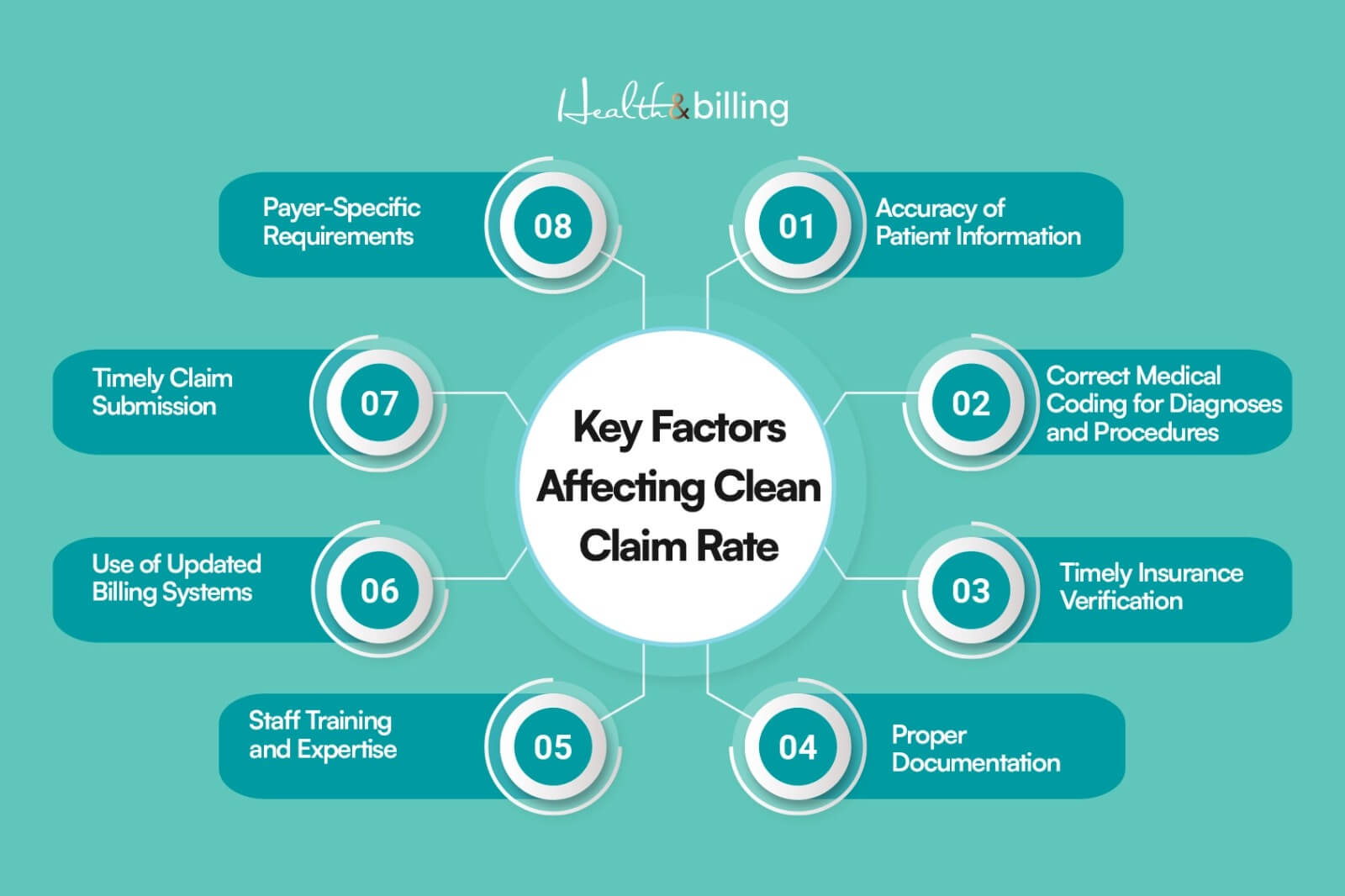
There are many reasons why a health insurance claim is rejected by the payer. Putting in the right information regarding the patient and the service rendered is the key element.
It strongly increases the chances of the claim being processed in the first attempt. However, this is something providers continue to struggle with, leading to delays and claim denials.
The clean claim rate is affected by the following factors, and even small errors in these areas can significantly reduce it.
1. Accuracy of Patient Information
Incorrect or incomplete patient details are one of the most common reasons for claim rejection.
Errors in names, dates of birth, insurance ID numbers, or policy details can cause immediate denials.
Verifying and updating patient information at every visit is essential to avoid these issues.
2. Correct Medical Coding for Diagnoses and Procedures
Using accurate and up-to-date codes (ICD and CPT) is critical. Coding errors, or medical billing errors, such as mismatched diagnosis and procedure codes, outdated codes, or missing modifiers, can result in claim denials or underpayments.
Proper medical coding ensures that the services provided are clearly justified and reimbursed correctly.
3. Timely Insurance Verification
Failure to verify insurance eligibility and benefits before providing services can lead to rejected claims.
Checking coverage details, policy status, co-pays, and pre-authorization requirements in advance helps prevent billing surprises. Also they ensure smoother claim processing.
4. Proper Documentation
Incomplete or insufficient clinical documentation can delay or invalidate a claim.
Payers often require detailed records to support the services billed. Clear, accurate, and thorough documentation strengthens claim validity and reduces the likelihood of audits or denials.
5. Staff Training and Expertise
A well-trained billing and coding team plays a crucial role in maintaining a high clean claim rate in medical billing.
Lack of knowledge about coding updates, payer requirements, or billing procedures can lead to repeated errors. Regular training and skill development help minimize mistakes and improve efficiency.
6. Use of Updated Billing Systems
Outdated or inefficient billing software can increase the risk of errors and missed information.
Modern billing systems with automation, error-checking features, and real-time updates help streamline the claim submission process and reduce manual mistakes.
7. Timely Claim Submission
Delays in submitting claims can lead to rejections due to payer filing deadlines.
Each insurer has specific time limits;… missing them can result in permanent revenue loss.
8. Payer-Specific Requirements
Different insurance companies have unique billing guidelines, formats, and documentation requirements.
Not adhering to these specific rules.. such as claim formatting or required attachments.. can cause claims to be rejected even if the information is otherwise correct.
Common Challenges in Maintaining High Clean Claim Rates

The scope of burden on a healthcare provider makes it impossible for them to have a 100% clean claim rate every time.
There are several challenges that can affect claim accuracy at a medical facility. These include:
→ Frequent Changes in Payer Policies
The policies of an insurance company are constantly changing. They have a penchant for regularly updating their billing rules, coverage criteria, and even documentation requirements.
Claims may be rejected or delayed if billing teams continue to submit claims using outdated guidelines.
→ Complex Coding Requirements
The medical coding system is not for the weak. Sometimes, high patient influx can result in the medical billing team selecting the incorrect code or mismatched diagnosis and procedure codes.
This draws out the reimbursement process with back and forth between the provider and payer.
→ Manual Data Entry Errors
Most healthcare practices still rely on manual documentation of patient and billing data.
In these cases, the risk of human errors, such as typos, incorrect numbers, or missing details, increases.
→ Incomplete Patient Information
Both the patient and the provider have the potential to log incorrect details regarding the former’s demographics, insurance ID, or policy coverage.
This could prevent the claims from being timely processed.
→ Lack of Standardized Workflows
The staffing situation at a medical practice has a significant impact on claim submissions and processing.
Having the billing process handled by a qualified professional or outsourcing an expert medical billing team, such as Health & Billing, greatly reduces the chances of errors.
Importance of Clean Claims in Medical Billing

Maintaining clean claims is essential for both financial stability and operational efficiency of an organization. The importance of clean claims in healthcare can be gauged by a simple understanding that the practices that are deemed better performing with good revenue have higher clean claim rates. It results in:
Faster Reimbursements
For healthcare practices, what is better than quick payment for their services? A clean claim is quickly processed, ensuring timely reimbursements.
Reduced Claim Denials
When all the details are ironed out in an insurance claim submitted by healthcare providers, they are rarely rejected or sent back for rework.
Lower Administrative Costs
A clean claim is the only right way to make sure the administrative team spends less time correcting and resubmitting claims and more time streamlining the operations of the practices.
Improved Cash Flow
A medical practice requires consistent payments and minimal delays to maintain financial stability. This is where a clean claim becomes essential.
Better Revenue Cycle Management
The overall billing performance and complete RCM is improved due to efficient claims processing by a healthcare provider.
Common Reasons Claims Are Rejected?

To increase the clean claim rate of healthcare practices, it is important to understand why claims are rejected in the first place. This helps prevent future errors and improves chances of first-pass claim acceptance.
- Incorrect or missing patient information.
- Coding errors or mismatches.
- Lack of prior authorization.
- Duplicate claims.
- Invalid or expired insurance details.
- Missing documentation.
Best Practices to Improve Clean Claim Rate!

Improving the clean claim rate of a healthcare practice requires a combination of accuracy, technology, and process optimization. They must adhere to the following practices for minimal errors and claim denials:
- Verify patient and insurance information before submission.
- Ensure accurate and updated medical coding.
- Use automated billing software.
- Keep staff up-to-date with payer guidelines.
- Conduct regular audits of claims.
- Implement standardized billing workflows.
- Monitor and analyze claim rejection trends.
- Outsource an expert medical billing team.
Clean Claim Rate vs Denial Rate!
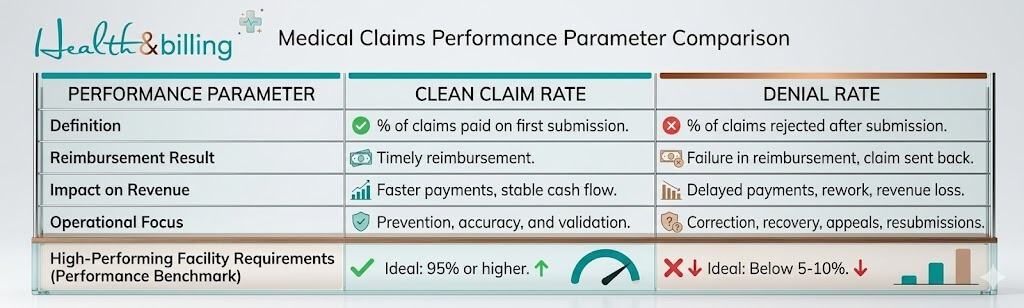
Both the clean claim rate and the denial rate are parameters of medical billing used to indicate either acceptance or denial of an insurance claim.
The key differences are:
- Definition → A clean claim rate measures the percentage of claims processed and paid on the first submission without errors. Denial rate measures the percentage of claims that are rejected by the insurer after submission.
- Reimbursement Result → A clean claim rate reflects timely reimbursement of services by first-pass claim acceptance. A denial rate reflects failure in reimbursement, leading to the claim being sent back.
- Impact on Revenue → High clean claim rate leads to faster payments and stable cash flow. High denial rate leads to delayed payments, rework, and revenue loss.
- Operational Focus → A clean claim rate focuses on prevention through accuracy and validation of a claim. Meanwhile, denial rate focuses on correction and recovery through appeals and resubmissions.
- Performance Benchmark → The ideal benchmark for clean claim rate is 95% or higher; denial rate needs to be below 5-10% for a healthcare facility to be considered high-performing.
Reduce Denials and Boost Clean Claim Rate with Health & Billing!
The standard of a healthcare practice is reflected by a good, clean claim rate. However, its management requires expertise, precision, and continuous monitoring.
At Health & Billing, we understand how much of an impact errors can have on the revenue and workflow efficiency of a practice.
We have a proven record to 98% claim approval. Our expert team helps providers optimize their medical billing process by improving claim accuracy, reducing denials, and accelerating reimbursements using advanced innovations in RCM.
FAQs
What is a clean claim in medical billing?
A clean claim in medical billing is exactly what the name suggests: an insurance claim free of errors that is processed without any rejections or delays.
What is a good clean claim rate?
A good clean claim rate in health insurance is 95% or higher, according to the industry benchmarks. Anything below that may indicate cash flow restrain and revenue loss.
Why is the clean claim rate important in healthcare billing?
A clean claim rate is an appropriate indicator of how good a medical practice is doing on the financial front as it measures the percentage of claims processed by the insurer on first submission.