
21May

How To Switch Medical Billing Services Without Disrupting Cash Flow?

If you are looking to switch medical billing companies, you might be thwarted by the fear of disruption of cash flow. The mere idea of transitioning systems, handing over accounts receivable, and retraining workflows can feel daunting – especially when revenue cycles in healthcare are already under pressure.

But remember.. at the same time, sticking with an underperforming in-house medical billing team or medical billing services has its own drawbacks. Industry data shows that nearly 12% of medical claims are denied on first submission to the insurance companies. This leads to payment delays, administrative burden, and revenue uncertainty. 

Thus, as risky as it sounds, a well-planned medical billing transition is crucial for protecting the revenue of a healthcare facility. Though it all comes down to timing, process, and choosing the right medical billing company as your RCM partner. 


Signs It’s Time to Switch Medical Billing Services

Doctor or nurse worried about claim denial, reducing clean claim rate due to claim errors

Medical billing issues often hide in plain sight until they gradually begin to impact the revenue and operations of a medical practice. The warning signs can be categorized into financial, operational, and compliance roadblocks. 

1. Financial Warning Signs 

The financial health of a facility is disrupted due to inefficiencies in claim submission by medical billing companies as well as inconsistent follow-up. The signs include: 

  • Increasing claim denial rates. 
  • Delayed reimbursements or inconsistent cash flow. 
  • Lack of transparency in the record and reporting. 
  • Rising accounts receivable (AR days). 

2. Operational Warning Signs 

One of the telltale signs that a healthcare facility needs to switch their medical billing company is the operational inefficiency, such as: 

  • Poor communication or slow response times. 
  • Frequent billing errors or resubmissions. 
  • Lack of process standardization. 
  • Over-reliance on manual workflows. 

3. Compliance Warning Signs 

Medical billing transition becomes paramount when operational issues start resulting in financial penalties. The compliance warning signs include: 

  • Incomplete or inaccurate documentation. 
  • Coding inconsistencies. 
  • Failure to stay updated with payer policies. 
  • Increased audit risk. 

Benefits of Switching to the Right Medical Billing Company 

illustration showing increasing graph of revenue of halthcare due to good clean claim rate and switiching to trusted medical billing service

Successful switching of medical billing companies has a direct effect on the overall performance of a healthcare facility. It is more than fixing money problems. The benefits include: 

→ Improved Revenue Cycle Efficiency

As part of their revenue cycle management service, a good outsourced medical billing service company ensures faster claim processing and reduced denials. 

→ Better Cash Flow Predictability 

Consistent reimbursements become a norm and delays are significantly reduced when a good medical billing service is outsourced. 

→ Reduced Administrative Burden 

The in-house staff at a medical practice can focus on clinical tasks by spending less time managing issues associated with billing. 

→ Enhanced Compliance

A reliable medical billing services provider is well-versed in payer guidelines, proper coding, and documentation. 

→ Scalability 

A healthcare facility can handle patient volume and increased revenue without needing to expand internal staff or increase operational burden. 


Health & Billing is your trusted medical billing services partner. We help healthcare providers streamline revenue cycle operations, reduce administrative burden, and improve financial performance with fully compliant and efficient billing solutions.  Contact Now, to discuss your concerns…


The Medical Billing Transition Process: Step-by-Step 

If a practice opts to outsource medical billing services, it must approach it in phases rather than a single handoff. This reduces risk and ensures continuity. 

Stage 1: Billing Audit and Assessment Before Transition 

Before switching medical billing companies, it is critical for a healthcare facility to have knowledge of the current state of its billing operations. 

This includes: 

  • Reviewing denial trends and AR aging. 
  • Identifying revenue leakage points. 
  • Evaluating coding accuracy and documentation. 
  • The step may take a week or two.

Stage 2: Selecting the Right Billing Partner

A healthcare facility should avoid choosing a medical billing company on the basis of its cost alone. 

Instead, they must: 

  • Evaluate expertise in the clinic’s specialty. 
  • Review reporting transparency and KPIs. 
  • Assess communication and support structure. 

Choosing the right billing partner can solve the issues without losing revenue. 

Stage 3: Parallel Billing Phase

Instead of switching abruptly, the current and new medical billing service provider companies work side-by-side for a short period. This part of the medical billing transition process helps minimize disruption and allows for real-time adjustments for both the provider and the billing company. 

  • Existing billing partner continues current claims. 
  • New partner begins handling new submissions. 
  • Processes are tested and refined. 

Stage 4: AR Transition & Full Handoff

Once the workflows are stable, two weeks are typically required to: 

  • Transfer outstanding claims. 
  • Reassignment of follow-ups and collections. 
  • Full billing responsibility shifts to the new partner. 

Stage 5: Performance Monitoring and Optimization 

Even after the handoff, the medical billing transition continues to evolve to ensure the long-term success of the partnership. 

In this phase, providers: 

  • Track KPIs such as denial rates and collection timelines. 
  • Identify process improvements. 
  • Ensure consistent communication and reporting. 

Though a bit time-consuming, the aforementioned medical billing transition process ensures it goes smoothly without disrupting cash flow.


Common Challenges When Switching Services to a New Medical Billing Company

illustartion about revenue code in medicla billing

Even with thorough planning and considerations, challenges can arise when a practice chooses to switch medical billing companies. These include: 

→ Temporary Workflow Disruptions

A healthcare facility may experience interruptions in daily billing operations during the transition. Though they are typically short-term and reversible.

→ Data Migration Errors

If the current medical billing service or in-house team fails to transfer complete or accurate data, it can lead to missing information, claim issues, or reporting inconsistencies.

→ Miscommunication Between Teams

Lack of clear coordination between outgoing and incoming billing teams can result in confusion over responsibilities and claim handling.

→ Delays in Claim Processing During Transition

As healthcare providers adjust to the medical billing transition, claims may take longer to submit or process as workflows stabilize, potentially slowing down reimbursements in the short term.


How to Avoid Cash Flow Disruptions During Transition?

Cash flow of a medical practice is often the biggest concern while switching medical billing companies. To make sure the transition occurs without losing revenue, providers should: 

  • Maintain a parallel billing period. 
  • Ensure clear ownership of claims during transition. 
  • Track daily billing activity and submissions. 
  • Prioritize high-value and aging claims. 
  • Maintain strong communication between both teams. 

Key Considerations for Choosing a Billing Partner 

Healthcare providers must consider the following when choosing a medical billing partner: 

  • Expertise in the required specialty. 
  • Transparency in reporting and KPIs. 
  • Technology and automation capabilities. 
  • Knowledge of compliance. 
  • Communication and responsiveness. 

Questions to Ask Potential Medical Billing Partners…

A good medical billing company acts as an extension of a healthcare practice rather than just a service provider. This is why it is so important to do a thorough evaluation before hiring one. 

The following questions can reveal both the capability and the accountability of a billing company. 

  • How do you handle claim denials and appeals?
  • What is your average turnaround time for claims?
  • How do you ensure compliance with payer regulations?
  • What reporting and performance metrics do you provide?
  • How do you manage billing transitions?

How Long Does a Billing Transition Take?

A typical billing transition depends on several factors. However, it may take 6 to 12 weeks in general.

The key factors include:

  • Size of the medical practice.
  • Volume of claims.
  • Complexity of billing processes.
  • Data migration requirements.

However, performance stabilization may take up to 3–5 months, especially during optimization phases.


Red Flags to Avoid in a Medical Billing Service

healthcare billing team analyzing denied insurance claims for appeal and correction

Certain warning signs may be pointing at deeper operational issues within a medical billing company and thus should be avoided for partnership. These include:

  • Lack of transparency in reporting.
  • No clear KPIs or performance tracking.
  • Poor communication or delayed responses.
  • Overpromising results without process clarity.
  • Limited experience in your specialty.

Outsource Billing to Health & Billing For a Better Revenue!

A seamless billing transition starts with the right partner. With a HIPAA-compliant medical billing company such as Health & Billing, you get structured onboarding, transparent reporting, and expert-led revenue cycle management. 

We make sure the switch is smooth, secure, and built for long-term performance.

Book your FREE consultation now!


FAQs

Can changing billing companies affect cash flow? 

Yes, medical billing company transition can temporarily affect cash flow of a healthcare practice. However, a structured handover process helps maintain consistent billing and minimize disruptions.

Can my new billing company pursue claims my old company already denied?

Yes, in many cases denied claims can be reviewed and reworked if they are still within the payer’s filing limits and supported by proper documentation. 

How long does it take to switch medical billing services? 

A medical billing transition typically takes 6–12 weeks, depending on practice size, claim volume, and the complexity of the billing system.


13May

What Is Meant by Recoupment in Medical Billing? 

In medical billing, successful payment processing is not always the end of the story. In fact, a claim may have been processed, reimbursed & recorded from the insurer’s end. Yet, it can still be taken back from the healthcare provider weeks or even months later. This is called recoupment, and it can directly affect the revenue stability and cash flow of a practice. 

Recoupment typically occurs due to billing errors, overpayments, or insurance audits. It serves as a mechanism for payers to recover incorrect payments. Though it is not always a good idea for the providers. 


What Is Recoupment in Medical Billing? 

Recoupment in medical billing is the process where an insurance company recovers money it has already paid to a healthcare provider. This typically happens if a billing issue, such as overpayment, is identified during a routine audit. 

In case of medical recoupment, insurance companies do not request a direct payment. Instead, they often deduct the amount from future claim payments. 


Why Does Recoupment Happen in Healthcare Billing?

illustration of a doctor looking a form for retro authorization of a process

Insurance recoupment occurs when there is a mismatch between what was billed and what should have been paid. There are many reasons, including: 

  • Overpayment due to billing errors.
  • Incorrect coding or documentation. 
  • Duplicate claims submission. 
  • Services deemed not medically necessary. 
  • Changes in insurance policy.
  • Eligibility issues

It is also known as claim overpayment recovery. 


How Does the Recoupment Process Work? 

The healthcare recoupment process usually follows a structured workflow: 

  1. Identification of overpayment: The insurance company identifies discrepancies in claims during audits. 
  2. Notice to provider: The payer sends a recoupment notice to the healthcare provider. It usually contains the reason and amount of recoupment.  
  3. Adjustment or deduction: The insurer goes on to deduct the overpaid amount from future reimbursements.
  4. Provider response: The healthcare provider may review, accept, or appeal the payer recoupment.

This is usually the standard process for recoup payment, though it may vary depending on payer policies. 


Types of Recoupments in Medical Billing 

The claim overpayment recovery usually depends on the policies of the insurance companies. It may follow one of these forms: 

→ Automatic Recoupment 

The insurance company deducts the amount directly from future payments to the providers.

→ Demand Recoupment 

The payer sends out a request to the provider for a refund. 

→ Post-payment Audit Recoupment

An audit is conducted at the payer’s end to identify and recover overpayments. Once done, they send a notice to the healthcare provider of intent to recoup payment. 

→ Coordination of Benefits (COB) Recoupment 

Insurer reclaims payments after another insurer has been identified as the primary payer. 

In simple terms, each type of recoupment of medical billing is done to adjust previously paid funds.


Causes of Recoupment in Medical Billing 

illustartion about recoupment in medicla billing

An issue as preventable as payer recoupment does not typically reflect well on the healthcare provider. Yet, it is a common occurrence due to issues within the medical billing cycle. 

The common causes of recoupment in medical billing include: 

1. Coding Errors

If a billing team uses incorrect diagnosis codes during claim submission, it can lead to medical services being billed at the wrong level. This results in overpayment that insurers later recover. 

2. Documentation Gaps

An insurance company may initiate recoupment process if a healthcare provider fails to provide relevant clinical records to support the services billed. 

3. Duplicate Billing

If an insurer ends up paying multiple times for a single service. This usually happens when the same claim is submitted more than once – either intentionally or due to system errors. 

4. Eligibility Errors 

If the patient does not have active coverage for an insurance plan, yet the billing team submits a claim without eligibility verification, that must be later reversed. 

5. Wrong Service Reporting 

Sometimes, healthcare team may report a higher or lower level of service than what was actually provided. This triggers audits at the insurer’s end, leading to payment corrections and recoupment.


What is the Difference Between Recoupment and Refund? 

Recoupment and refund may be used interchangeably in everyday life. In medical billing, however, these are not the same. 

→ Initiation Source

Recoupment is typically initiated by the insurance company for claim overpayment recovery. Meanwhile, refund is initiated by the provider. 

→ Method of Payment Recovery 

For recoupment, the most common method is that the insurance company deducts the recovery amount from future payments to the provider. In case of a refund, provider returns payment directly. 

Reason

Payer recoupment usually follows an audit or claims review by the insurer. As for refund, provider may do it voluntarily after identifying an error. 


Impact of Recoupment on Healthcare Providers

Doctor or nurse worried about claim denial, reducing clean claim rate due to claim errors

Healthcare providers typically bear the brunt of payer recoupment. It has a significant impact on operational and financial health of a practice.

→ Cash Flow Disruption. Providers may suffer revenue loss and disruption in daily cash flow due to unexpected recoupment deductions in future payments. 

→ Administrative Burden. Having to review recoupment notices, gather documentation, and potentially filing for appeal takes time away from core health operations for the staff. 

→ Increased Audit Scrutiny. Insurers may develop trust issues toward providers in case of frequent recoupments. This could lead to them conducting more audits and closely monitoring future claims.  


Can Providers Appeal Recoupment? 

Upon receiving a recoupment notice, providers possess the right to appeal the decision via the following process:

  1. Reviewing the recoupment notice.
  2. Gathering supporting documentation.
  3. Submitting a formal appeal within the payer’s timeline.

However, the appeal may or may not be successful, depending on:

  • The original claim was billed correctly.
  • Adequate documentation supports medical necessity.
  • The payer made an error in assessment.

Insurance companies typically have strict deadlines and documentation requirements for recoupment appeals.


Ways to Prevent Recoupment in Medical Billing

Though at times uncertain, recoupment is completely preventable via key strategies such as:

  • Verifying patient eligibility before services.
  • Ensuring accurate coding and documentation.
  • Conducting internal audits regularly.
  • Training staff on billing compliance.
  • Using reliable billing software or services.

These proactive measures reduce both errors and financial risk for a healthcare practice.


Best Practices for Managing Recoupment in Medical Billing

illustartion about revenue code in medicla billing

Despite the best efforts, payer recoupment becomes inevitable in some cases. 

Thus, there are ways to effectively manage it without falling in the crisis hole.

→ Track Recoupment Trends. It is essential for providers to identify recurring issues leading to recoupments.

→ Maintain Organized Records. Providers must ensure quick access to documentation in case of recoupment so they can file for appeal. 

→ Prompt Response to Notices. To avoid escalation of the claim recoupment process, providers must be hands-on to dealing with notices from payers.

→ Establish Internal Review Protocols. Claims must be reviewed for correct information and documentation before being submitted to the insurance company.

→ Leverage Billing Expertise. To improve accuracy and reduce administrative burden, claim recoupment specialists are one of the better options to go for.

The above practices help minimize disruption and improve overall revenue cycle performance.


How to Handle a Recoupment Notice?

Similar to the structured approach of a payer when submitting a recoupment notice, providers must also adhere to a standard process in case of receiving one. 

This includes:

  • Thoroughly reviewing the reason for recoupment.
  • Verifying claim details and documentation.
  • Determining whether the recoupment is valid
  • Deciding to accept or appeal.
  • Submitting a response within deadline.

Bottom Line!

Recoupment usually means there are gaps in accuracy of billing in a medical practice.

Reach out to Health & Billing today to get expert-driven claim management, reduced errors, and stronger revenue cycle control.


FAQs

What does recoupment mean in medical billing?

Recoupment in medical billing is the process by which an insurance company recovers money from a provider in case of an overpayment error.

Can providers appeal a recoupment?

Yes, healthcare providers can absolutely appeal a recoupment. Though, it must be within the deadline set by the payer.

What is the difference between recoupment and refund?

Recoupment is the claim for overpayment recovery by the insurer. Meanwhile, a refund is typically done on the provider’s end.

How can medical practices avoid recoupment?

Medical practices can avoid recoupment by carefully reviewing the claim to make sure all the information is correct before submitting it to the insurer.

07May

What Is Coinsurance? Meaning, Examples & How It Works?

Many patients may assume they no longer have financial responsibility for their medical bills once their insurance starts covering costs. The reality sets in when the bill arrives & they see hundreds or even thousands owed to their name. 

This typically happens due to coinsurance, which refers to the distribution of medical expenses between the patient and the insurer after the deductible is met. 

As one of the biggest drivers of unexpected healthcare bills, it is essential to understand how coinsurance works to avoid potential financial surprises.


What Is Coinsurance? 

pen, sthetoscope, medical bills, and insurance documents showing coinsurance cost calculation.

Coinsurance is the percentage of a medical bill that a patient must pay after meeting their deductible. The remaining cost is covered by the insurance provider.

For example, in an 80/20 coinsurance plan: 

→ The insurer pays 80%. 

→ The patient pays 20%. 

Coinsurance is not a fixed amount. In fact, it is cost-dependent, which means the higher the total medical expense, the higher the patient’s share.


Examples of Coinsurance

Coinsurance becomes easier to understand when applied to real numbers.

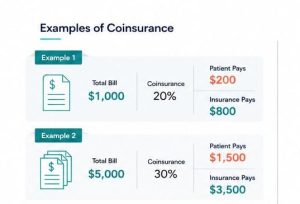
Examples of Coinsurance

Example no. 1

Let’s say the total bill is $1,000 and the deductible has already been met. If the coinsurance is 20%, that means the patient pays $200, leaving insurance to cover the remaining $800. 

Example no. 2

If the total bill is $5,000 and coinsurance is 30%, the patient will pay $1,500, while the insurance pays $3,500. 

Coinsurance plays a major role in overall healthcare cost-insurance since expenses can increase significantly for hospital stays, surgeries, or advanced imaging. 


Importance of Coinsurance in Medical Billing 

concept image of family under umbrella showing protection offered by insurance for helath expenses

A health plan coinsurance is not merely a patient cost. Instead, it directly affects revenue collection and payment timelines at the provider’s end.

It determines: 

  • The patient’s financial responsibility after insurance has been processed. 
  • How much must providers collect from patients… 
  • Payment delays due to confusion or disputes. 

For patients, coinsurance is one of the most common reasons behind the financial burden of medical bills. 

Therefore, conditions associated with coinsurance must be clearly communicated beforehand to avoid billing issues and improve collections. 


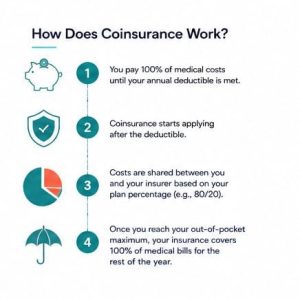
How Does Coinsurance Work in Health Insurance?

how does coinsurance work in health insurance?

For a better understanding of how does coinsurance work in health insurance, providers offer a structured process.  

  1. The patient pays 100% of medical costs until their annual deductible is met. 
  2. Coinsurance starts applying after the deductible. 
  3. Costs are shared between the patient and insurer based on the plan percentage, such as 80/20 coinsurance.
  4. Once you have reached yearly limit for out-of-pocket costs, the insurance provider covers 100% of medical bills for the rest of the year. 

What Is Coinsurance After Deductible? 

Patient making a medical payment while reviewing hospital billing and insurance coverage details.

Coinsurance after deductible simply means that once the patient has paid their deductible, which applies annually, they begin splitting costs with the insurer.

For example: 

The annual deductible in a patient’s insurance plan amounts to $1,000, and the coinsurance percentage is 20%. The patient will initially cover their medical bills all by themselves until meeting the deductible. 

Once it is finished, the insurance starts helping as per the predetermined coinsurance percentage. For every medical bill, the patient pays 20%, while the remaining 80% will be covered by the insurer.


How Do You Calculate Coinsurance?

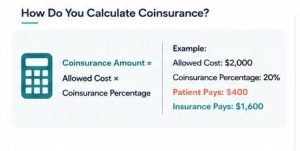
How Do You Calculate Coinsurance?

Coinsurance in healthcare insurance is calculated using a simple multiplication of the total allowed cost-insurance of medical services by the predetermined percentage (e.g., 20%). 

Coinsurance Amount = Allowed Cost * Coinsurance Percentage

In the aforementioned formula, allowed cost or allowed amount refers to the maximum price the insurer agrees to pay for a medical service. Coinsurance percentage is the portion of the medical bill owed by the patient after meeting the deductible. 

Example: 

  • Allowed cost: $2,000
  • Coinsurance percentage: 20%
  • Patient pays: $400
  • Insurance pays: $1,600 

What Are Common Coinsurance Percentages?

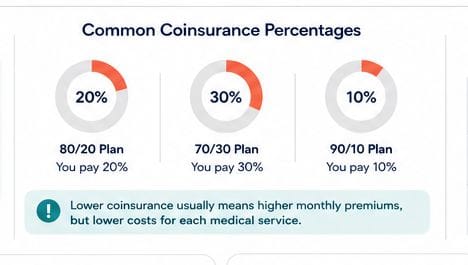
What Are Common Coinsurance Percentages?

Common coinsurance percentages are typically expressed as a split between the insurer and the patient. Though they vary depending the insurance plan, common structures include: 

  • 80/20 plan: Patient pays 20%. 
  • 70/30 plan: Patient pays 30%. 
  • 90/10 plan: Patient pays 10%. 

If the coinsurance percentage is low, it means the patient is paying a higher monthly premium amount for insurance. In these cases, the patient pays less for each medical service.


Coinsurance vs Copay vs Deductible 

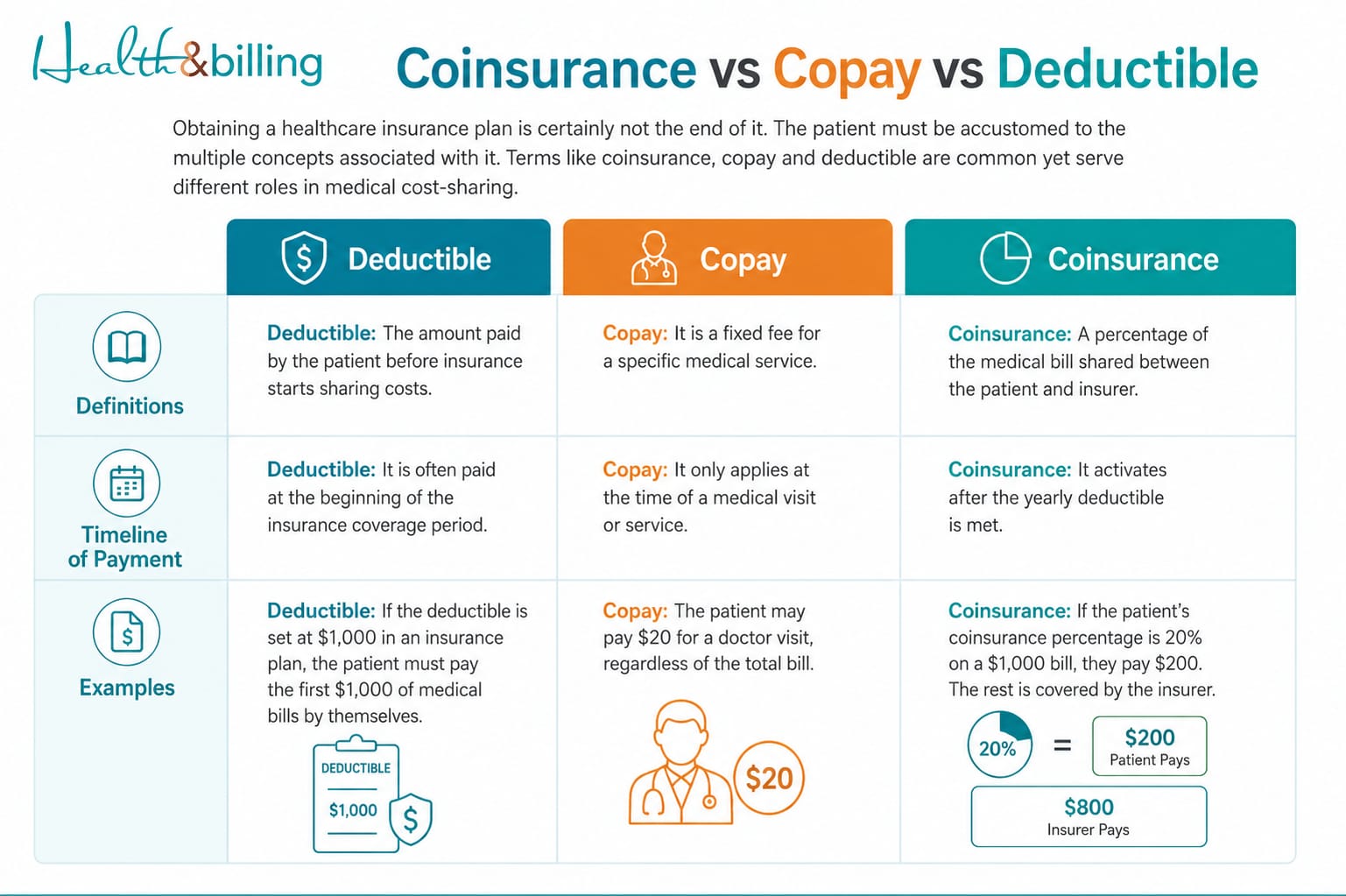
infographics about Coinsurance vs Copay vs Deductible 

Obtaining a healthcare insurance plan is certainly not the end of it. The patient must be accustomed to the multiple concepts associated with it. Terms like coinsurance, copay and deductible are common yet serve different roles in medical cost-sharing. 

→ Definitions

Deductible: The amount paid by the patient before insurance starts sharing costs. 

Copay: It is a fixed fee for a specific medical service.

Coinsurance: A percentage of the medical bill shared between the patient and insurer. 

→ Timeline of Payment 

Deductible: It is often paid at the beginning of the insurance coverage period. 

Copay: It only applies at the time of a medical visit or service. 

Coinsurance: It activates after the yearly deductible is met. 

Copays often apply from day one, while coinsurance typically waits for the deductible.

→ Examples

Deductible: If the deductible is set at $1,000 in an insurance plan, the patient must pay the first $1,000 of medical bills by themselves.

Copay: The patient may pay $20 for a doctor visit, regardless of the total bill. 

Coinsurance: If the patient’s coinsurance percentage is 20% on a $1,000 bill, they pay $200. The rest is covered by the insurer. 


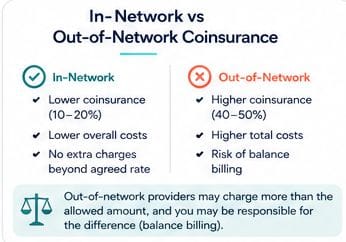
In-Network vs Out-of-Network Coinsurance

Coinsurance is not the same for every healthcare provider. Instead, it depends heavily on whether they are in-network, i.e., they have a contract with the patient’s insurance company, or out-of-network, i.e., the provider does not have a contract with the insurer. 

In case of in-network co-insurance, the healthcare provider may agree to provide services at pre-negotiated rates. 

It typically means: In-Network vs Out-of-Network Coinsurance

  • Lower coinsurance percentage (e.g., 10-20%).
  • Lower overall costs.
  • No extra charges beyond the agreed rate.

For out-of-network providers: 

  • Coinsurance percentage is typically higher (e.g., 40-50%). 
  • Higher total costs. 
  • Risks of extra financial burden. 

With out-of-network care, the provider may charge more than the allowed amount on the patient’s insurance plan. This is called balance billing. 

For example, the hospital charges are $1,500. The allowed amount for the particular medical service is $1,000 on the patient’s insurance plan. Meanwhile, the coinsurance percentage is 50%. The patient pays 50% of the $1,000, i.e., $500 as well as the extra $500 of the doctor’s charges. This way, the insurance only covers $500 of the total medical bill for an out-of-network provider. 


Common Mistakes People Make About Coinsurance     

Proper understanding of coinsurance is essential for patients to avoid unexpected expenses linked to their medical bills. Some of the common mistakes they make about coinsurance include: 

  • Many people may assume that insurance pays everything once the deductible is met. However, coinsurance means the patient still shares a percentage of the cost. 
  • Patients sometimes confuse coinsurance with copays, which is the fixed amount they pay on a doctor visit. 
  • Patients may end up bearing larger medical bills if they ignore the higher coinsurance rates associated with out-of-network providers. 
  • Since coinsurance applies to high-cost procedures and calculated on the total cost, it may result in high out-of-pocket payments for patients. 

Out-of-Pocket Maximum and Its Relation to Coinsurance 

Patient making a medical payment while reviewing hospital billing and insurance coverage details.

In medical billing, the out-of-pocket maximum is the annual limit of what a patient must pay for services typically covered in their healthcare insurance plan. 

Once this limit is reached, the payer covers 100% of the covered costs and coinsurance no longer applies. 

For example, if the out-of-pocket max is $6,000, patients are not required to pay any coinsurance payments after reaching it. 

Out-of-pocket maximum aims to provide financial protection to patients against extremely high medical expenses. 


How Does Coinsurance Affect Your Medical Bills? 

Doctor or nurse worried about claim denial, reducing clean claim rate due to claim errors

In medical billing, coinsurance plays a major role in determining actual healthcare costs. It especially carries a substantial financial impact for high-cost services and out-of-network care. 

If a patient’s health plan shows higher coinsurance, the patient is responsible for greater out-of-pocket expenses. It also poses increased financial risk on them for expensive procedures. 

In the case of lower coinsurance, the costs are much more predictable and manageable since the patients are responsible for a smaller portion of each bill. It is often due to higher monthly premiums, where they pay more upfront for the insurance plan. 


Bottom Line

Coinsurance is a core component of health insurance that defines how costs are shared between the patient and the insurer. Confusion around it often leads to billing delays and patient disputes. 

Partner with Health & Billing to get accurate cost breakdowns and streamlined billing support for your practice.


FAQs

Do I pay coinsurance before deductible? 

No, coinsurance typically applies only after you have met your deductible. Before that, you usually pay the full cost of medical services.

What is a good coinsurance percentage? 

A lower coinsurance percentage, such as 10-20% is ideal because it means you pay less out of pocket for each service.

Can coinsurance be avoided?

Coinsurance usually can’t be avoided if you have obtained a healthcare insurance plan. Thus, it is often recommended to choose plans with lower coinsurance percentage. 

15Apr

Everything You Need to Know About Revenue Code in Medical Billing!

A medical revenue code identifies the type of service provided and the hospital department in which it was provided. It plays a critical role in how insurance claims are processed and how healthcare providers are reimbursed.

In medical billing, precision is everything. Revenue codes are a key part of that accuracy. A revenue code is a standardized numeric identifier.

The significance of the revenue code is reinforced by the fact that even small errors can lead to claim rejections, underpayments, or compliance issues at the insurer’s end.


What Are Revenue Codes in Medical Billing?

illustartion about revenue code in medicla billing

A revenue code in medical billing refers to a 4- digit number used to identify the type of service or department where a patient received care. The department responsible for delivering that service. 

Revenue codes are maintained by the National Uniform Billing Committee. It standardizes billing elements for institutional claims in the United States. These codes appear on institutional claims, specifically the UB-04 (CMS-1450) form, and are not used on professional billing forms like the CMS-1500.

In simple terms, revenue codes help insurers understand both the nature of the service and also where within the facility it was provided.

For instance, one code may represent physical therapy services. Another may indicate diagnostic imaging. While another could correspond to operating room usage. Each code groups similar charges into standardized categories. Thus, making it easier for payers to interpret claims.

However, revenue codes alone do not fully describe the service. They are used in combination with CPT (Current Procedural Terminology) or HCPCS (Healthcare Common Procedure Coding System) codes.

While CPT or HCPCS codes specify the exact procedure performed. Revenue codes add context. It is done by identifying the service area or cost center within the facility. Together, they ensure that claims are both detailed and properly structured.

When applied correctly, revenue codes reduce the risk of claim denials, minimize payment delays, and improve overall billing accuracy. Even small inconsistencies between revenue and procedure codes can create issues, which is why careful coding is critical in the revenue cycle process.


Structure of Revenue Code

Revenue codes typically consist of four digits, with each having a specific meaning. 

The first digit often represents a broad category, such as the hospital department. The remaining digits define a specific service group within that category. 

For example, 0450 is the revenue code for general services at the emergency room. However, they can be sub-categorized into more specific ER services.  


Revenue Codes vs. Medical Codes vs CPT Code 

In medical billing, coding systems play a crucial role in describing a patient encounter. Due to the distinct purpose of each type of code, it is important to use them correctly in order to ensure accurate claim processing and reimbursement. 

Revenue Codes vs. Medical Codes vs. CPT Codes

AspectRevenue CodesMedical Codes (General)CPT Codes
DefinitionFour-digit codes used to identify the department or service category within a healthcare facility.A broad category of standardized codes used to describe diagnoses, procedures, and services in healthcare.A specific set of procedure codes used to describe medical, surgical, and diagnostic services.
PurposeIndicate where and under what category a service was provided.Provide a complete picture of patient care, including diagnosis, treatment, and services.Specify what exact procedure or service was performed.
Used InInstitutional claims (UB-04 / CMS-1450).Used across all healthcare documentation and billing systemsProfessional and institutional claims (CMS-1500 and UB-04).
Code FormatTypically 4 digits (e.g., 0420, 0360).Varies (ICD, CPT, HCPCS, etc.).5-digit numeric codes (e.g., 99213).
DescribesDepartment or cost center (e.g., radiology, physical therapy).Diagnoses (ICD), procedures (CPT), supplies/services (HCPCS)Specific procedures like exams, surgeries, or tests.
Level of DetailGeneral category-level information.Can range from broad to highly specific depending on code set.Highly specific to the procedure performed.
Maintained ByNational Uniform Billing Committee (NUBC).Multiple organizations (WHO for ICD, AMA for CPT, CMS for HCPCS)American Medical Association (AMA).
Role in BillingSupports claim structure and categorizes charges.Essential for complete medical billing and documentation.Determines reimbursement for specific procedures.
Used Alone?No, used with CPT/HCPCS codes.No, used in combination depending on need.No, often paired with diagnosis and revenue codes.
Focus“Where and category of service”“What condition and what service”.“What exact procedure was performed”.


Here are some major differences between different codes in medical billing: 

→ Purpose. Revenue codes are used to identify the department or location of the service. CPT codes are more specific to medical procedures and services performed. 

→ What It Describes. A medical revenue code described the “where” of care, for example, the emergency room, lab, or surgery room. CPT codes describe the “what” of care, for example, X-ray, consultation, or surgery. 

→ Where It Is Used. Revenue codes are mostly used in hospitals, while CPT codes are often used by physicians for outpatient billing. 

In addition to revenue and CPT codes, another medical code that is commonly used in insurance claims is the ICD-10 codes, more commonly known as diagnosis codes. It is essentially used to describe the “why” of care, i.e., the reason behind a specific service being provided to the patient.   

All three medical codes come together to give the insurance company a complete picture of a patient visit. 


Importance of Revenue Codes in Medical Billing 

illustartion about revenue code in medicla billing

Revenue codes are essential for accurate claim submission and timely reimbursement for services provided to a patient. 

They are important to: 

1. Correct Categorization of Services

Revenue codes help classify exactly what type of service was provided such as lab, radiology or emergency. Insurers must have this information to accurately process claims.

2. Proper Claim Processing

They guide insurance companies in understanding how to review and route the claim within their system.

3. Accurate Billing and Reporting

Correct coding of a medical service ensures that hospital can track services properly and generate accurate financial reports

4. Maintain Compliance with Payer Requirements

Many insurers require specific revenue codes, so correct usage helps avoid audits or penalties.

Absence of correct revenue codes can lead to misinterpretation or rejection of claims by the insurers. 


How Revenue Codes Impact Reimbursement? 

Medical revenue codes have a direct impact on how much and how quickly a provider gets paid. Insurance companies use these codes to decide how a service should be categorized. 

They also help in matching the services to the right payment policies and contract terms.

If the revenue code is correct, the claim is processed smoothly and reimbursed according to the contract. In case of an incorrect or missing revenue code, payments can be reduced, delayed, or even denied. 


Common Mistakes in Revenue Coding 

The complexity of medical billing may often lead to making mistakes in coding and subsequently affect claim processing following a hospital visit. Here are some common mistakes associated with revenue coding in medical billing: 

→ Using Incorrect or Outdated Codes

Old or wrong codes can make claims invalid under current payer rules.

→ Mismatching Revenue and CPT Codes

If the service location doesn’t match the procedure code, insurers may reject the claim.

→ Missing Revenue Codes on Claims

Incomplete claims delay processing or get denied outright.

→ Lack of Specificity in Coding

Using vague codes does not give enough detail for insurers to approve payment.


Best Practices for Using Revenue Code Effectively 

To maintain accuracy and efficiency in medical billing, providers should follow below practices:

  • Regularly update coding knowledge and guidelines. 
  • Ensure proper alignment between revenue, CPT, and other medical codes. 
  • Use billing software to minimize manual errors. 
  • Conduct routine audits of claims. 
  • Train staff on payer-specific requirements. 

These strategies, once implemented, improve claim accuracy and reimbursement outcomes for a medical practice. 


Common Revenue Code Examples 

Here are some commonly used revenue codes:

0250 – Pharmacy (general).

0300 – Laboratory services.

0360 – Operating room services.

0450 – Emergency room services.

0510 – Clinic services.

These codes help categorize services across different healthcare departments.


Where Revenue Codes Are Used?

illustartion about revenue code in medical billing

Revenue codes are mainly used in institutional healthcare settings, such as hospitals, outpatient facilities, skilled nursing facilities, or ambulatory surgical centers. 

These codes are essential in facility-based billing because they help organize services by department and ensure that each part of a hospital stay is properly documented and reimbursed.  


Optimize Your Revenue Cycle with Experts!

We specialize in end-to-end medical billing and revenue cycle management (RCM) at Health & Billing… services for U.S. healthcare standards.

Are you struggling with coding errors? Or delayed payments? Or complex claim requirements?

Our experienced team is here to streamline your billing process and maximize your revenue.


Let us handle the complexities. So you can focus on patient care!

Get in touch with Health & Billing today. 

Share your deal to improve your billing accuracy, reduce denials, and accelerate reimbursements.


FAQs

What is a revenue code? 

A revenue code is a type of medical code used to identify the location of a service provided by a healthcare practice. 

What is the difference between revenue codes and CPT codes? 

Revenue codes are used to describe where a healthcare service was provided i.e., the department of a hospital. CPT codes describe what service was provided, i.e., X-ray, surgery etc.

Do revenue codes affect insurance reimbursement? 

Yes. Incorrect or missing revenue codes can lead to claim delays. You will have reduced payments or even denials because insurers use them to determine how services should be categorized and reimbursed.

05Apr

Prior Authorization in Medical Billing | Process, Challenges, and Solutions.

Prior authorization in medical billing is the process by which a healthcare provider obtains approval from a patient’s insurance company before providing certain medical services, procedures, or medications.

While patients visit clinics seeking timely care, navigating insurance requirements can be confusing. 

Known as pre-authorization or pre-approval… this step helps ensure that recommended treatments are covered, medically necessary, and cost-effective.

Although it aims to protect patients from unexpected expenses, it can sometimes lead to delays, paperwork, and administrative hurdles. 

Understanding how prior authorization works can help patients receive care efficiently and avoid surprise bills.


What is Prior Authorization in Medical Billing? 

healthcare provider seeking insurance approval before medical treatment, representing prior authorization in medical billing.

As the name suggests, prior authorization refers to seeking approval in advance of a medical procedure. Healthcare providers are typically required to run it by the insurance companies before performing specific procedures, prescribing medications, or offering treatments. 

As a cost-management tool, prior authorization is only required for specific high-cost, non-urgent procedures, diagnostic tests, and specialized medications. It is not a pre-requisite should a patient walks in with a medical emergency. 


Importance of Prior Authorization for Patients 

While it may seem like a roadblock to medical care to some, prior authorization plays a key role in the exchange of care between the provider and patients. 

→ Confirm Insurance Coverage Before Treatment

One of the most important elements of receiving a healthcare service is making sure that it is covered by the patient’s insurance plan. 

Thus, prior authorization is a convenient way to alleviate patients’ concerns regarding the cost of services.

→ Reduce Unexpected Costs

By getting a rundown of a patient’s insurance plan, they can verify costs in advance and thus avoid surprise bills or out-of-pocket costs. 

→ Ensure Medical Necessity of Procedures

The patient’s condition is thoroughly gauged to confirm that the treatment prescribed by the provider is appropriate and justified.

→ Prevent Unnecessary or Duplicate Treatments

Prior authorization helps ensure patients are not subjected to repeated tests or procedures that are not medically needed. 

Regardless, efficient handling of the authorization process is essential since delays in approval can impact timely access to care.


Types of Prior Authorization in Medical Billing 

Medical professional reviewing insurance documents to obtain prior authorization before performing a procedure.

The types of prior authorization in medical billing depend on the service being requested. These include: 

1. Procedure Authorization 

This type of prior authorization is required when a patient has been prescribed a surgery or similar specialized medical procedure. This ensures the procedure is medically necessary for the patient’s condition. Furthermore, providers also double check its coverage under the insurance plan.

2. Medication Authorization 

This applies to expensive, brand-name, or non-standard medications. Prior authorization entails verification that lower-cost alternatives have been considered first. 

3. Diagnostic Authorization 

Healthcare providers reach out to insurance companies for authorization of advanced imaging tests like MRIs or CT scans. 

4. Referral Authorization 

This type of prior authorization is required when a patient needs to see a specialist. This helps avoid unexpected costs. By making sure the visit is covered and coordinated within the insurance network. 


The Prior Authorization Process 

The prior authorization process involves the following steps before a treatment can be rendered to a patient by their healthcare provider: 

  1. The healthcare provider examines the patient and forms a treatment plan based on the diagnosis. 
  2. They look through the patient’s insurance plan to determine whether prior authorization is required for the proposed treatment. 
  3. Following confirmation, the provider submit authorization request to the insurance company with supporting clinical documentation, such as medical records, diagnosis information, treatment plans, and justification for medical necessity. 
  4. The insurance company reviews the submitted request to assess whether the service meets their coverage criteria. They check factors like medical necessity, policy guidelines, and whether alternative treatments should be considered first. The approval can take days or weeks. 
  5. The insurer then sends over their response, which may include approval of the claim, denial, or even a request for additional information. 
  6. In case of denial, the provider may need to revise the request or initiate an appeal with further documentation. 
  7. The treatment is finally delivered once approval is received. However, it must align with the authorization details to avoid claim denials or reimbursement issues later. 

Common Challenges in Prior Authorization!

: Comparison of traditional paper-based remittance and modern electronic remittance advice in medical billing.

Prior authorization is one of the more complex aspects of medical billing that involves thorough documentation of services rendered by a healthcare provider to a patient. 

Though the step ensures authentication that a treatment is medically necessary and covered by insurance… it is bound by a plethora of challenges that may pose as a roadblock for timely medical care. 

These challenges include: 

  • Time-consuming paperwork and administrative burden. 
  • Delays in approval are affecting patient care. 
  • Frequent request denials or additional documentation requirements. 
  • Lack of standardization across insurance providers. 
  • Communication gaps between providers and payers. 

These challenges can slow down operations and increase workload for healthcare staff.


Impact of Inefficient Prior Authorization on Revenue and Patient Care 

Medical professional reviewing insurance documents to obtain prior authorization before performing a procedure.

When prior authorization is not managed efficiently, it can negatively affect both the financial performance of a medical practice as well as patient outcomes.

→ Revenue Impact

1 Delayed Reimbursement

Insurance companies may hold or reject claims if the healthcare provider fails to obtain prior authorization before delivering patient care. 

This can slow down cash flow to a practice and make it difficult to manage day-to-day operational expenses. 

Physician surveys show that 94% reported that prior authorization can delay the necessary care. When required.

2. Increased Claim Denials

In case of missing or incorrect prior authorization in medical billings, the proportion of claim denials drastically increases as insurers may refuse to pay for the service altogether. 

This leads to an extra burden on healthcare staff to either appeal the claim or absorb financial loss. 

3. Higher Administrative Costs

Inefficient handling of prior authorizations increases workload on staff as it requires a significant portion of their time for documentation, follow-ups, and communication with insurers. 

→ Patient Care Impact 

In fact, nearly 60% of insured adults who needed prior authorization found the process hard to manage… and almost half experienced delays or denials from their insurer. Highlighting the real burden patients face.

1. Delayed Treatments 

Patients may be forced to wait for approval before receiving necessary procedures, tests, or medications. 

It is especially detrimental for serious or time-sensitive conditions, affecting the effectiveness of treatment. 

2. Reduced Patient Satisfaction

Patients often get frustrated due to long wait times associated with prior authorizations. Moreover, repeated paperwork and uncertainty about approvals also negatively impact their healthcare experience. 

3. Increased Risk of Condition Worsening 

When prior authorization is not managed efficiently, it can negatively affect both financial performance and patient outcomes.


Prior Authorization vs Claim Denial: Key Differences!

Though both terms are related to insurance plans, prior authorization and claim denials are not the same. 

→ Time Period. Prior authorization is typically done by healthcare providers before the service is provided. Meanwhile, claim denials happen after the claim is submitted. 

→ Payment Approval. Prior authorization ensures the payment is approved before the treatment is given, while claim denial refers to when the insurer refuses payment. 

→ Preventative vs. Corrective. Prior authorization is essentially done to prevent billing issues such as claim denials later in the medical procedure. 


Simplify Prior Authorization with Expert Support from Health & Billing!

Prior authorization can pose multiple challenges to healthcare providers without the right systems and expertise. 

At Health & Billing, we provide dedicated support to streamline prior authorization workflows for many specialities in medical billing. 

From handling documentation to tracking approvals, our experienced team ensures timely submissions to help healthcare providers reduce delays to the right care at the right time.


Struggling with prior authorization delays and denials? 

Partner with Health & Billing today and simplify your workflow for faster patient care delivery.


FAQs

What is prior authorization in medical billing?

Prior authorization in medical billing refers to the process of seeking approval from the insurance company before providing a medical service to a patient. 

What is the difference between prior authorization and preauthorization?

There is no real difference between the two; the terms are used interchangeably to describe obtaining approval from the insurer before treatment.

How long does prior authorization take? 

It can take a few days or it can take several weeks to get the approval. It really depends on how complicated the request is and which insurance company you are dealing with.

Do all insurance companies require pre-authorization?

Not all medical services need authorization but most insurance companies do require it for things that are very expensive or specialized or, for treatments that are not routine.

16Mar

Understanding EOB in Medical Billing | Everything You Need to Know

After a medical appointment, many patients are surprised to receive multiple documents from their insurance company. One of the most commonly misunderstood is the Explanation of Benefits (EOB).

While it may look like a bill at first glance, an EOB is actually a breakdown of how your insurance processed a claim. It helps you understand what was covered, what was paid, and what you may still owe. 

Learning how to read an EOB can make a significant difference in managing healthcare costs and avoiding unexpected charges.


What is an Explanation of Benefits (EOB)?

Healthcare insurance concept showing medical documents, calculator, and payment breakdown related to Explanation of Benefits

An Explanation of Benefits (EOB) is a statement sent by your insurance company following medical claim adjudication, which refers to the process of reviewing and deciding how much the insurer will pay for a healthcare service. The document contains a detailed insurance payment breakdown, including the billed amount, allowed amount, payer reimbursement, and, lastly, any remaining expenses owed to the patient. 

By explaining the outcome of health insurance reimbursement, the document helps both patients and providers get the gist of how insurance claims have been processed. It typically includes information such as covered services, non-covered charges, claim adjustment codes, and payment details. 

It is pertinent to note that an EOB is distinct from a medical bill. It is easier to remember it as an explanation of one.


Purpose of an EOB Statement 

The primary function of an Explanation of Benefits statement is to ensure transparency in insurance claim management after a service is rendered by a medical practice. Both patients and healthcare providers are educated on how insurance payments are calculated and applied. 

The key functions of an EOB are: 

→ Shows the insurance payment breakdown.

→ Explain what services were covered by insurance.

→ Identifies financial responsibility on patient.

→ Highlights contractual adjustments and payer reductions.

→ Helps patients verify billing accuracy.

With the help of a clean insurance claim summary laid out in the EOB, the patients are able to understand what their insurance covers; meanwhile, providers are able to track payer reimbursement accurately.


Role of EOB in the Medical Billing Process 

Medical billing professional reviewing insurance documents and Explanation of Benefits statements in office setting

The Explanation of Benefits statement serves as a crucial link to the medical billing workflow and Revenue Cycle Management (RCM). It connects insurance claim processing with payment posting and accounts receivable in healthcare. 

Here’s a breakdown of the process: 

  1. The patient receives a medical service from a healthcare provider – either in-network or out-of-network.
  2. The healthcare provider assigns CPT codes, ICD-10 codes, and HCPCS codes to document the services performed. 
  3. The provider submits the claim to the insurance company.
  4. The claim is reviewed by them through medical claim adjudication 
  5. The insurance company issues payer reimbursement and generates an EOB. 
  6. The provider uses the EOB for payment posting and accounts receivable tracking.

Key Components of an EOB in Medical Billing

An Explanation of Benefits statement has a clear set of sections to help explain insurance payments and patient costs.

  1. Patient and Provider Information: Includes patient name, provider name, and service details. 
  2. Date of Service: Helps track when the medical service was performed. 
  3. Billed Amount vs. Allowed Amount: The billed amount is what the provider charged, while the allowed amount is what the insurance company is owed. 
  4. Contractual Adjustments: Often labeled as CO (Contractual Obligation), it is the difference between the billed amount and the allowed amount. 
  5. Insurance Payment: The portion of charges paid by the insurance company. 
  6. Patient Financial Responsibility: This includes deductibles, coinsurance, copays, and other costs to be covered by the patient. 
  7. Covered Services and Non-Covered Charges: Includes a list of services covered by insurance and those not. 
  8. Claim Adjustment Codes and Remark Codes: These include adjustment reason codes (CARC), remittance remark codes (RARC), denial codes, and payer explanations. 

What Does an EOB Look Like?

Similar to other medical documents, an Explanation of Benefits statement usually appears as a structured report, either in paper or electronic format. The tables usually include listed services, CPT codes, billed charges, allowed amount, insurance payment, and patient responsibility. 

It may also include claim adjustment codes, denial codes, and remarks explaining reductions or non-covered services. Electronic versions of the EOB can be accessed through insurance portals. 

A similar document called Electronic Remittance Advice (ERA) is also received by providers that helps with payment posting and healthcare billing solutions. 


Types of EOB Statements 

The two types of Explanation of Benefits statements depend on how they are delivered and the type of insurance. 

→ Paper EOB

A printed insurance claim summary sent by mail. 

→ Electronic EOB

Also called eEOB, the statement is available through insurance portals. 

EOBs are often received by patients, while providers receive remittance advice or Electronic Remittance Advice (ERA). It contains detailed payment information for Revenue Cycle Management. 


How to Read Your EOB like a Pro?

Learning how to read an EOB helps patients understand insurance statements and avoid billing confusion.

Follow these steps:

  • Verify patient and provider details.
  • Review services listed and corresponding CPT codes.
  • Compare the billed amount vs the allowed amount.
  • Check insurance payment and contractual adjustments.
  • Identify deductible, copayment, and coinsurance amounts.
  • Review adjustment reason codes and remark codes.

Understanding your EOB helps answer common questions such as “Why did I receive an EOB?” and clarifies the EOB vs medical bill difference.

If you notice errors or unexpected charges, you can contact your insurance provider or healthcare provider to dispute an insurance claim or request clarification.


Common EOB Terms Explained!

Understanding common medical billing terms makes it easier to interpret your EOB.

Deductible

The amount you must pay before insurance begins covering services.

Copayment (Copay)

A fixed amount you pay for certain healthcare services.

Coinsurance

The percentage of costs you share with your insurance provider.

Allowed Amount

The maximum amount of insurance agreed to pay for a service.

Contractual Adjustments (CO)

The amount written off due to insurance agreements.

Patient Responsibility (PR)

The portion of costs the patient must pay.

Other Adjustment (OA)

Adjustments due to secondary insurance or other factors.

Payer Initiated Reduction (PI)

Payment reductions made by the insurance company.

Denial Codes and Remark Codes

Codes explaining claim denial management decisions or adjustments.

Understanding these terms helps patients interpret their insurance payment breakdown more confidently.


EOB vs ERA vs COB: Key Difference 

Though related, these terms serve different purposes in medical billing.

EOB (Explanation of Benefits): Sent to patients to explain insurance claim processing and payment decisions.

ERA (Electronic Remittance Advice): Sent to providers in electronic format to assist with payment posting and revenue optimization.

COB (Coordination of Benefits): Used when a patient has secondary insurance to determine which insurance pays first. It is essential to ensure proper payer reimbursement and prevent duplicate payments.


Why is an EOB Important?

Understanding Explanation of Benefits (EOB) in Medical Billing

The Explanation of Benefits statement plays a vital role for both patients and healthcare providers.

For patients, it helps them understand insurance coverage with a thorough guide on out-of-pocket costs. It also helps in the verification of covered services and non-covered charges, and identifying billing errors. 

Meanwhile, an EOB supports payment posting and accounts receivable tracking for healthcare providers, helps with claim denial management, denial resolution services, and underpayment recovery. The basic purpose of the statement is to ensure healthcare compliance and accurate payer reimbursement. 


Tips for Managing Your EOBs!

Efficient management of your Explanation of Benefits statements properly can help you stay informed and avoid billing issues. The tips to consider are: 

  • Always review your insurance claim summary carefully.
  • Compare your EOB with your medical bill.
  • Keep copies of all EOB statements.
  • Contact your provider if something seems incorrect.
  • Use insurance portals to access electronic EOBs.
  • Understand your patient’s financial responsibility.

Properly reviewing EOBs helps ensure accurate insurance claim processing and protects you from billing errors.


Need Help Managing EOBs and Insurance Claims?

Understanding an Explanation of Benefits is only the first step… accurately posting payments, resolving denials, and tracking patient responsibility require expertise and time.

Health & Billing offers end-to-end medical billing and revenue cycle management solutions designed to simplify EOB processing, improve claim accuracy, and maximize payer reimbursement.

Whether you need help with:

  • Payment posting and EOB reconciliation
  • Claim denial management and appeals
  • Underpayment identification and recovery
  • Accounts receivable follow-up
  • End-to-end Revenue Cycle Management (RCM)

Our experienced billing professionals are here to support your practice every step of the way.

Contact the Health & Billing team today!

Streamline your billing operations, reduce administrative burden, and focus on what matters most—patient care.


FAQs

What if you don’t receive an EOB?

If you are not receiving an EOB following a medical visit, check your insurance portal or contact your insurer. There are chances it may still be processing or has been delivered electronically.

What to do if you disagree with an EOB?

After thoroughly reviewing the details and comparing the EOB with your medical bill, you are welcome to contact your insurance company for clarification. In some cases, you can also file an appeal.

What to do if your EOB and medical bill don’t match?

Contact the healthcare provider’s billing office first, as the bill may not yet reflect insurance adjustments shown in the EOB.

How long should you keep your EOB?

It is wise to keep your EOB for at least 1-2 years, or even longer if it relates to ongoing treatment.

Is an EOB a bill?

No, an EOB is not a bill; it is a summary of what your insurance paid and what you are owed to your healthcare provider. 

25Feb

A Complete Guide To Payment Posting In Medical Billing!

Every dollar your practice earns must be accurately tracked, reconciled, and recorded. Payment posting is the critical step. As it ensures insurance reimbursements and patient payments are correctly applied to the right accounts. 

While it may seem like a routine administrative task, it directly impacts your healthcare revenue cycle management, financial reporting, and overall cash flow.

When payments are posted incorrectly… or delayed… it can trigger claim denials, billing discrepancies, patient dissatisfaction, and revenue loss. 

Accurate payment posting not only reflects the true financial health of your practice but also strengthens your entire revenue cycle management (RCM) process.

A report by the American Medical Association states that close to 1 out of every 5 medical claims is not approved or processed, which is usually caused by avoidable administrative mistakes. Correct and prompt recording of payments is at the center stage of reducing such losses and maintaining healthy revenue cycles.

Let’s learn about the definition of payment posting in medical billing, its importance, how it works, and what should be done to achieve best practices and technology in improving the accuracy of payment posting.


What Is Payment Posting in Medical Billing?

The procedure of entering the payments received by insurancepayers and patients (a medical practice) into the billing system is known as payment posting. Such payments are balanced with respective claims and patient accounts, which makes balances updated properly.

Posting payments also entails the use of contractual adjustments, denials, and underpayment flagging. In the absence of this step, one would be unable to tell the claims that are completely paid, part paid, or those that need follow-up.


Why Payment Posting Is Important in the Revenue Cycle? 

The payment posting is the revenue cycle’s financial gateway. It confirms that the services that were billed were correctly reimbursed and that further measures may be required. Precise posting of payments assists in practices:

  • Monitor in-flight revenue growth.
  • Determine payment patterns and underpayment.
  • Have proper patient balances.
  • Denial management and appeals.

According to the Healthcare Financial Management Association, inefficient revenue cycle procedures may increase administrative expenditures by up to 30 percent, and thus, posting payment processes may need to be streamlined.


Types of Payment Posting in Medical Billing

Two primary types of payment posting in medical billing are applied in healthcare organizations.

Medical billing professional entering insurance and patient payments into billing software

→ Manual Payment Posting

Employees check the explanation of benefits (EOBs) and key information on payments into the system. Although this technique is useful in the close examination, it is both time-consuming and more likely to error human perception.

→ Electronic Payment Posting (ERA Posting)

ERA files are sent into the billing software directly, and the payment can be recorded automatically. This approach is more precise and quicker in case systems are correctly set.


Medical Billing Payment Posting Process

The post-billing process is structured and has a sequence that guarantees accuracy.

A well-managed payment posting process not only ensures accuracy… but it also strengthens your practice’s cash flow. It reduces claim delays. And also improves overall revenue cycle performance.

The payment posting process in medical billing is a structured, multi-step workflow designed to ensure financial accuracy, compliance, and proper revenue tracking. 

Each step plays a critical role in maintaining the financial health of a medical practice.

Payment posting specialist manually reviewing explanation of benefits and posting payments into system

1. Payment Receipt and Identification

Payments are first received through various channels. It can include insurance checks, Electronic Funds Transfer (EFT), credit card payments, and patient portal transactions.

Each payment must be accurately identified and matched with the corresponding payer and claim.
At this stage, supporting documents such as Explanation of Benefits (EOB) for paper payments or Electronic Remittance Advice (ERA) for electronic payments are also received.

2. Verification of EOBs and ERAs

The next step involves carefully reviewing the EOB or ERA to verify:

  • Billed charges.
  • Allowed amounts (as per payer contracts).
  • Deductibles, copays, and coinsurance.
  • Contractual adjustments.
  • Denials or reductions.

This comparison ensures that insurance companies have reimbursed the correct contracted amount… Also, that no discrepancies exist between what was billed and what was paid.

3. Accurate Payment Posting

Verification done. Now, payments are posted to the appropriate patient accounts. It is done within the billing software. 

Each transaction is allocated correctly to:

  • Insurance payments.
  • Patient responsibility balances.
  • Contractual adjustments.
  • Write-offs (if applicable).

Accuracy at this stage is critical… Why?

Because even small posting errors can lead to reporting inaccuracies, billing confusion, or compliance risks.

4. Denial and Underpayment Identification

During posting, any denials, partial payments, or underpayments are flagged for follow-up. These discrepancies may result from coding errors, missing documentation, eligibility issues, or payer processing mistakes. 

Prompt identification allows the billing team to initiate appeals, submit corrected claims, or pursue additional reimbursement.

5. Reconciliation and Reporting

This is the final step. It involves reconciling posted payments. Reconciliation is done with bank deposits and generating financial reports. 

These reports help track:

  • Collection trends.
  • Payer performance.
  • Denial patterns.
  • Outstanding accounts receivable.

Consistent reporting ensures transparency, supports revenue cycle management (RCM) strategy, and helps practices identify areas for financial improvement.


Key Components of Payment Posting in Medical Billing

When recording payment posting in the medical billing flow chart, several items need to be confirmed:

  • Claim identification and patient identification.
  • Amount paid by payer
  • Contractual adjustment quantities.
  • Responsibility of the patient (copay, deductible, coinsurance)
  • Denial or remark codes

Individually, each component assists in deciding the next course of action, whether it be closing the claim, billing the patient, or making an appeal.


How Payment Posting Impacts Accounts Receivable (A/R)?

payment posting specialist explaining medical invoice

Accuracy and aging from insurance payment posting have a direct impact on the accuracy and aging of accounts receivable. When payments are recorded properly and in a timely manner, A/R reports are inclusive of real outstanding balances.

Benchmark practices in the industry indicate that the practice of high performance has A/R days not above 40 days, whereas inefficient practice has A/R days not below 60 days, and the days are binding a lot of revenue.

Proper posting will see that the unpaid claims are recognized promptly and will be processed in a short duration, reducing the aging and increasing the cash flow.


Common Healthcare Payment Posting Errors in Medical Billing!

ealthcare billing team analyzing denied insurance claims for appeal and correction

Although payment posting is essential to revenue cycle management, it is highly prone to errors. Some common mistakes include:

→ Posting to the Wrong Patient Account. Applying payments to the incorrect account leads to inaccurate balances and patient confusion.

→ Entering the Wrong Payment Amount. Manual entry mistakes can distort financial reports and misrepresent accounts receivable.

→ Failure to Apply Contractual Adjustments. Not posting insurance write-offs correctly may result in inflated patient balances and compliance issues.

→  Missing Denials or Remark Codes. Overlooking denial explanations can delay follow-ups and reduce recovery chances.

→ Duplicate Payment Posting. Posting the same payment twice can create false credit balances and reconciliation problems.

→ Not Posting Patient Responsibility Properly. Failing to transfer deductibles, copays, or coinsurance to the patient portion may affect collections.

→ Delayed Payment Posting. Late posting impacts cash flow tracking. It makes financial reporting unreliable.

→ Incomplete Reconciliation with Bank Deposits. If posted payments do not match actual deposits, it can lead to revenue discrepancies.

These errors, if not monitored and corrected, can slow reimbursement, increase accounts receivable days, and result in revenue leakage.


Best Practices for Accurate Payment Posting!

Define Workflows and Standardize Them!

Adaptability in posting payment encompasses the use of a payment posting workflow to ensure that all payments are described, verified, and logged consistently. Standard operating procedures not only minimize the differences among staff members but also assist in ensuring the consistency of the accuracy of all types of payers. 

By documenting workflows, teams can operate under similar set procedures during the posting, reconciliation, and follow-up, and reduce confusion and delays.

Invest in Continued Training of the Staff

The payer rules, reimbursement models, and coding guidelines constantly evolve, and thus, to ensure the correctness of payment posting, it should be trained constantly. Periodic training is used to keep the staff informed about changes in the contract, denial codes, and payer-specific requirements. 

Having well-trained billers can help point out discrepancies, avoid errors when posting a bill, and also identify underpayments before the revenue is lost.

Carry out Daily Reconciliation of Payments

Each day, the deposits at the bank and the electronic transfer of funds are compared with the posted payments in the billing system. This will make sure that everything received is reflected in the account and utilized appropriately on the patient accounts. 

Timely reconciliation enables practices to identify untimely or misused payments in time before they can be compounded to impair financial reporting.

Carry out Internal Audits and Quality Check

On a regular basis, internal audits and random review of accounts are a bonus quality control. Audits are used to point out common errors, employee training failures, and system setups. 

Accountability can be enhanced through regular review of the transactions posted, as well as improving processes and ensuring the accuracy of posting is always improved.


The Role of Technology in Payment Posting

Billing staff manually reviewing explanation of benefits and posting payments into system

The payment posting process is automated by the modern practice management systems to a large extent. ERA auto-posting minimizes manual entries, whereas embedded denial management tools highlight the problems without the need to enter the data manually.

Automation of payment posting services has been found to minimize errors in posting and decrease the revenue cycle timelines. One of the studies published in Health Affairs revealed that automation can reduce the administrative expenses by as much as 25 percent.

Technology can also give reporting dashboards so that the payment posting specialists can monitor the trends and address areas of problems in an expedited manner.


Outsource Your Healthcare RCM, Medical Billing & Payment Posting with Health & Billing! 

By outsourcing payment posting, healthcare practices receive the opportunity to concentrate on patient care, and professional billing experts complete complicated financial tasks. Accurate and compliant professional billing partners are provided with the help of sophisticated technology, standard workflow practices, and trained professionals.

Looking for reliable medical outsource payment posting services? 

Outsourcing to Health & Billing will be a good and reliable solution to your practice in case your practice is facing problems with posting backlogs, errors, or cash flow difficulties.

Get a specialized team for the profitable revenue of your healthcare practice. Consult NOW!


FAQs

What is the main purpose of medical payment posting in medical billing?

To accurately record payments, adjustments, and denials so that accounts reflect true balances and next steps.

What are the typical challenges of payment posting?

High volume of payments, complex payer rules, and manual data entry increase the risk of errors.

Why is denial management linked to a payment posting company?

Denials are identified during posting and routed for correction or appeal.

How does payment posting help reduce denials?

Accurate posting highlights trends and root causes, allowing corrective action.

Why should practices outsource payment posting?

Outsourcing improves accuracy, reduces overhead, and accelerates cash flow.

15Feb

Understanding EOB in Medical Billing | Everything You Need to Know

In the U.S. healthcare system, utilizing a service is probably the easy part; it is the impending billing process that is more taxing. You ought to receive a myriad of insurance documents after a medical visit. Among those is the Explanation of Benefits statement, commonly known as EOB. This document plays arguably the most important role in insurance claim processing. It essentially shows the handling of your medical claim by the insurance company after a service has been rendered to you. 

Many patients may assume that an EOB is a bill. In reality, though, it is an insurance claim summary that explains the nature of services provided, what portion of the charges were covered by the insurance, and what is owed by the patient. The Explanation of Benefits statement is a help to both patients and providers in many insurance payments, adjustments, and coverage decisions, and is easy to understand. 


What is an Explanation of Benefits (EOB)?

Explanation of Benefits statement showing insurance claim details and patient responsibility

An Explanation of Benefits (EOB) is a statement sent by your insurance company following medical claim adjudication, which refers to the process of reviewing and deciding how much the insurer will pay for a healthcare service. The document contains a detailed insurance payment breakdown, including the billed amount, allowed amount, payer reimbursement, and, lastly, any remaining expenses owed to the patient. 

By explaining the outcome of health insurance reimbursement, the document helps both patients and providers get the gist of how insurance claims have been processed. It typically includes information such as covered services, non-covered charges, claim adjustment codes, and payment details. 

It is pertinent to note that an EOB is distinct from a medical bill. It is easier to remember it as an explanation of one. 


Purpose of an EOB Statement 

The primary function of an Explanation of Benefits statement is to ensure transparency in insurance claim management after a service is rendered by a medical practice. Both patients and healthcare providers are educated on how insurance payments are calculated and applied. 

The key functions of an EOB are: 

→ Shows the insurance payment breakdown.

→ Explain what services were covered by insurance.

→ Identifies financial responsibility on patient.

→ Highlights contractual adjustments and payer reductions.

→ Helps patients verify billing accuracy.

With the help of a clean insurance claim summary laid out in the EOB, the patients are able to understand what their insurance covers; meanwhile, providers are able to track payer reimbursement accurately.


Role of EOB in the Medical Billing Process 

Patient discussing Explanation of Benefits and insurance billing questions with provider

The Explanation of Benefits statement serves as a crucial link to the medical billing workflow and Revenue Cycle Management (RCM). It connects insurance claim processing with payment posting and accounts receivable in healthcare. 

Here’s a breakdown of the process: 

  1. The patient receives a medical service from a healthcare provider – either in-network or out-of-network.
  2. The healthcare provider assigns CPT codes, ICD-10 codes, and HCPCS codes to document the services performed. 
  3. The provider submits the claim to the insurance company.
  4. The claim is reviewed by them through medical claim adjudication 
  5. The insurance company issues payer reimbursement and generates an EOB. 
  6. The provider uses the EOB for payment posting and accounts receivable tracking.

Key Components of an EOB in Medical Billing

An Explanation of Benefits statement has a clear set of sections to help explain insurance payments and patient costs.

  1. Patient and Provider Information: Includes patient name, provider name, and service details. 
  2. Date of Service: Helps track when the medical service was performed. 
  3. Billed Amount vs. Allowed Amount: The billed amount is what the provider charged, while the allowed amount is what the insurance company is owed. 
  4. Contractual Adjustments: Often labeled as CO (Contractual Obligation), it is the difference between the billed amount and the allowed amount. 
  5. Insurance Payment: The portion of charges paid by the insurance company. 
  6. Patient Financial Responsibility: This includes deductibles, coinsurance, copays, and other costs to be covered by the patient. 
  7. Covered Services and Non-Covered Charges: Includes a list of services covered by insurance and those not. 
  8. Claim Adjustment Codes and Remark Codes: These include adjustment reason codes (CARC), remittance remark codes (RARC), denial codes, and payer explanations. 

What Does an EOB Look Like?

Medical billling professional reviewing medical invoice

Similar to other medical documents, an Explanation of Benefits statement usually appears as a structured report, either in paper or electronic format. The tables usually include listed services, CPT codes, billed charges, allowed amount, insurance payment, and patient responsibility. 

It may also include claim adjustment codes, denial codes, and remarks explaining reductions or non-covered services. Electronic versions of the EOB can be accessed through insurance portals. 

A similar document called Electronic Remittance Advice (ERA) is also received by providers that helps with payment posting and healthcare billing solutions. 


Types of EOB Statements 

The two types of Explanation of Benefits statements depend on how they are delivered and the type of insurance. 

→ Paper EOB

A printed insurance claim summary sent by mail. 

→ Electronic EOB

Also called eEOB, the statement is available through insurance portals. 

EOBs are often received by patients, while providers receive remittance advice or Electronic Remittance Advice (ERA). It contains detailed payment information for Revenue Cycle Management. 


How to Read Your EOB like a Pro?

Learning how to read an EOB helps patients understand insurance statements and avoid billing confusion.

Follow these steps:

  • Verify patient and provider details.
  • Review services listed and corresponding CPT codes.
  • Compare the billed amount vs the allowed amount.
  • Check insurance payment and contractual adjustments.
  • Identify deductible, copayment, and coinsurance amounts.
  • Review adjustment reason codes and remark codes.

Understanding your EOB helps answer common questions such as “Why did I receive an EOB?” and clarifies the EOB vs medical bill difference.

If you notice errors or unexpected charges, you can contact your insurance provider or healthcare provider to dispute an insurance claim or request clarification.


Common EOB Terms Explained!

Medical billing professional reviewing EOB and insurance claim reimbursement details

Understanding common medical billing terms makes it easier to interpret your EOB.

Deductible

The amount you must pay before insurance begins covering services.

Copayment (Copay)

A fixed amount you pay for certain healthcare services.

Coinsurance

The percentage of costs you share with your insurance provider.

Allowed Amount

The maximum amount of insurance agreed to pay for a service.

Contractual Adjustments (CO)

The amount written off due to insurance agreements.

Patient Responsibility (PR)

The portion of costs the patient must pay.

Other Adjustment (OA)

Adjustments due to secondary insurance or other factors.

Payer Initiated Reduction (PI)

Payment reductions made by the insurance company.

Denial Codes and Remark Codes

Codes explaining claim denial management decisions or adjustments.

Understanding these terms helps patients interpret their insurance payment breakdown more confidently.


EOB vs ERA vs COB: Key Difference 

Though related, these terms serve different purposes in medical billing.

EOB (Explanation of Benefits): Sent to patients to explain insurance claim processing and payment decisions.

ERA (Electronic Remittance Advice): Sent to providers in electronic format to assist with payment posting and revenue optimization.

COB (Coordination of Benefits): Used when a patient has secondary insurance to determine which insurance pays first. It is essential to ensure proper payer reimbursement and prevent duplicate payments.


Why is an EOB Important?

The Explanation of Benefits statement plays a vital role for both patients and healthcare providers.

For patients, it helps them understand insurance coverage with a thorough guide on out-of-pocket costs. It also helps in the verification of covered services and non-covered charges, and identifying billing errors. 

Meanwhile, an EOB supports payment posting and accounts receivable tracking for healthcare providers, helps with claim denial management, denial resolution services, and underpayment recovery. The basic purpose of the statement is to ensure healthcare compliance and accurate payer reimbursement. 


Tips for Managing Your EOBs!

Efficient management of your Explanation of Benefits statements properly can help you stay informed and avoid billing issues. The tips to consider are: 

  • Always review your insurance claim summary carefully.
  • Compare your EOB with your medical bill.
  • Keep copies of all EOB statements.
  • Contact your provider if something seems incorrect.
  • Use insurance portals to access electronic EOBs.
  • Understand your patient’s financial responsibility.

Properly reviewing EOBs helps ensure accurate insurance claim processing and protects you from billing errors.


Need Help Managing EOBs and Insurance Claims?

Understanding an Explanation of Benefits is only the first step… accurately posting payments, resolving denials, and tracking patient responsibility require expertise and time.

Health & Billing offers end-to-end medical billing and revenue cycle management solutions designed to simplify EOB processing, improve claim accuracy, and maximize payer reimbursement.

Whether you need help with:

  • Payment posting and EOB reconciliation
  • Claim denial management and appeals
  • Underpayment identification and recovery
  • Accounts receivable follow-up
  • End-to-end Revenue Cycle Management (RCM)

Our experienced billing professionals are here to support your practice every step of the way.

Contact the Health & Billing team today!

Streamline your billing operations, reduce administrative burden, and focus on what matters most—patient care.


FAQs

What if you don’t receive an EOB?

If you are not receiving an EOB following a medical visit, check your insurance portal or contact your insurer. There are chances it may still be processing or has been delivered electronically.

What to do if you disagree with an EOB?

After thoroughly reviewing the details and comparing the EOB with your medical bill, you are welcome to contact your insurance company for clarification. In some cases, you can also file an appeal.

What to do if your EOB and medical bill don’t match?

Contact the healthcare provider’s billing office first, as the bill may not yet reflect insurance adjustments shown in the EOB.

How long should you keep your EOB?

It is wise to keep your EOB for at least 1-2 years, or even longer if it relates to ongoing treatment.

Is an EOB a bill?

No, an EOB is not a bill; it is a summary of what your insurance paid and what you are owed to your healthcare provider.